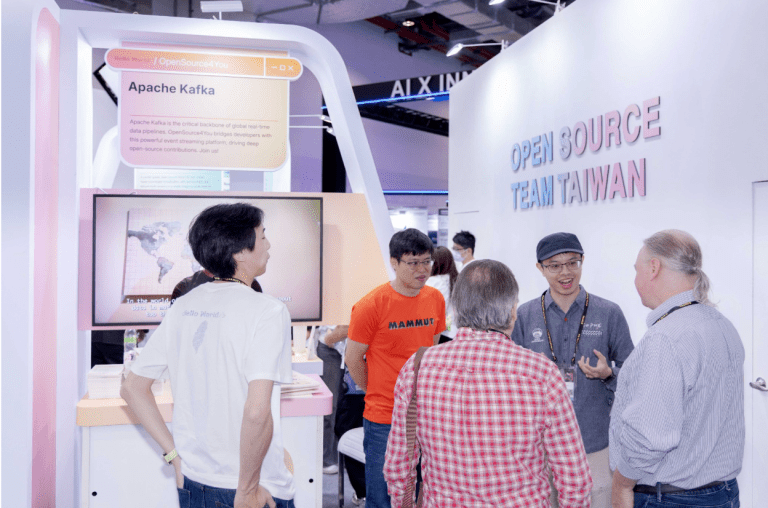
FOSDEM 2025 has come to a close, and it certainly was not without a lot of content and participation from ASF members, committers, and contributors! We asked ASF participants to provide summaries and observations from this year’s premier free software event, to share a small part of the work ASF community members do for open source software development. This blog provides a brief overview of their talks, including links to the video recordings.

Talk: SBOM journey for an Open Source Project – Apache NuttX RTOS (video)
Speaker: Alin Jerpelea, Sony
This was my second time presenting at FOSDEM, and I absolutely love the community and vibe during the Open Source week.
The talk was about presenting the community journey of license migration to Apache, SPDX header implementation, and the road bumps encountered when we started looking how-to implement SBOM automatic generation for a project, which is using the C language.
Learn more about Apache NuttX.
Talk: Forked Communities: Project Re-licensing and Community Impact (video)
Speaker: Brian Proffitt, Red Hat, ASF (with Dr. Dawn M Foster, Stephen Walli, and Ben Ford)
The increase of open source businesses changing their licensing from open source software licenses to something more restrictive is becoming a real concern in the open source ecosystem. MongoDB, Elasticsearch, HashiCorp’s Terraform / Vault, and Redis to name just a few, have shifted their projects to non-open source licenses (sometimes referred to as “source available”), despite there not being consistent evidence that this actually generates improved financial outcomes for those companies.
In some cases, this relicensing has resulted in a hard fork of the original project. Both the relicensing and the resulting fork create turmoil for the users of that project and the community of contributors.
Saturday at FOSDEM, I joined Dr. Dawn Foster from Project CHAOSS, Stephen Walli of Microsoft, and Ben Ford from Overlook InfraTech discussed the dynamics around relicensing that results in such hard forks; examples of forks along with the impact on the communities; and thoughts about what this means for the future of free and open source software.
The panel’s conclusion? For the most part, the forked projects tend to do better in terms of contributions and adoption growth, and there is real data coming in to support that. Technology is all well and good, but without truly open communities and contributor practices, even the coolest technologies might see less adoption when they are closed off.

Talks: Apache Arrow: The Great Library Unifier (video), ODBC Takes an Arrow to the Knee (video)
Speaker: Matt Topol, Voltron Data, Apache Arrow (PMC member), Apache Iceberg (committer)
This was my first FOSDEM, both attending and speaking. The event is simply amazing in sheer scope and size. Being free to attend, it attracts an enormous crowd such that even the smaller DevRooms or more niche topics are still likely to have a good amount of attendees. As of yet, it’s definitely my favorite open source event for finding like-minded people and making great connections over a beer (or several). This event gave me the opportunity to not only catch-up with friends that I’ve met at other conferences (like the ASF’s own Community Over Code), but also reunite in-person with several other Apache Arrow maintainers.
Given the size of FOSDEM, there are also a significant number of “Fringe” events organized by different companies and organizations. This gives you the opportunity to expand your circle of connections, knowledge of projects in whatever your preferred space of development is and have amazing conversations. The volume of talks and topics covered can be overwhelming at first, but ultimately it contributes to the friendly and casual nature of the best conferences. If you’re able to attend, I highly recommend adding FOSDEM to your list of must-go events. In the meantime, if you do any work in the data analytics space or are building AI/ML tools and utilities, check out the recordings of my talks (and the multitude of others) that have great information for everyone!
Learn more about Apache Arrow and Apache Iceberg.
Talks: Apache Arrow tensor arrays: an approach for storing tensor data (video), What can PyArrow do for you – Array interchange, storage, compute and transport (video)
Speakers: Rok Mihevc and Alenka Frim, Apache Arrow
Our first talk was a short 10 minutes pitch talk where we mainly explained the development of canonical tensor data type support in Arrow C++ and PyArrow. The aim of the talk was to present memory layout specification of the two tensor extension types, fixed and variable shape type, together with a Python example of creating a fixed shape tensor array and its interoperability with NumPy.
In the PyArrow talk we gave an overview of some of PyArrow’s capabilities, demonstrating data interchange, storage, manipulation and transport using a single Python library. We had to start with a short introduction of Apache Arrow and its Python implementation as the attendees were a mixed group of users and non-users. After that we gave a general overview together with code examples for each of the four PyArrow functionalities we decided to present: array interchange, storage (Parquet, ORC, etc.), compute module and Flight RPC. The response and questions we got showed us we picked a good theme and needed to do more presentations like this.
Read more about Apache Arrow.

Talk: Introducing Qumat, Apache Mahout’s new quantum compute layer (video)
Speakers: Trevor Grant, The AI Alliance (IBM) and Andrew Musselman, Speedchain
Following Apache Mahout’s core values of interoperability and providing tools for matrix arithmetic at scale, we have added a new layer (qumat) alongside our existing distributed matrix math framework (Samsara), that allows quantum researchers and developers to write code once and run it on any back-end available.

As with distributed compute systems like Spark and Flink, moving from one platform to another typically requires a complete code rewrite. This is prohibitive in most cases, but Samsara allows machine learning researchers and developers one unified interface to write code once and port instantly to another platform if it is deemed necessary.
Similarly for quantum computing, multiple vendors (IBM, GCP, and AWS to name a few) have their own libraries for accessing their cloud quantum compute services, such as qiskit, cirq, and braket. To give the same flexibility in the quantum area, qumat corrals all these libraries under one interface, allowing users to focus on building circuits and writing algorithms rather than adapting to one particular library.
Read more about Apache Mahout.
Talk: Building Bridges: Exploring the Future of Developer Relations BOF
Speaker: Nadia Jiang, Ant Group
Thanks to Willem Jiang for recommending this conference to me last year. This was my second time attending FOSDEM, which also marked its 25th anniversary. This year, I organized a Birds of a Feather (BoF) session on Developer Relations.
I was deeply impressed by the lively discussions and the connections made during the event. Participants ranged from DevRel professionals at major companies like Google to entrepreneurs from start-ups. Two key topics sparked the most heated discussions: how open-source projects can adapt their documentation, forums, and support in the face of AI advancements, and how to balance the responsibilities of DevRel (ensuring developer satisfaction) with customer support (ensuring client satisfaction).
The diverse experiences and insights shared were truly inspiring.

Talk: Airflow Beach Cleaning – Securing Supply Chain (video)
Speaker: Jarek Potiuk, Apache Airflow (with Munawar Hafiz, Michael Winser)
This was my third FOSDEM and I absolutely love the event. It’s hands-down the best place where you can not only share your stories, but also meet people that “think” Open Source, have a beer (or two) with them and make connections that make your Open Source journey more enjoyable and successful. In my first event I was an attendee, I had a talk at the second, the third one – I co-organized “Low-level AI Engineering and Hacking” with Roman. This is how you can see you can fall-in-love with the event and people around it.
This year – I had the opportunity to catch-up with my friends and they could learn from me what I am doing, meet completely new people (AI is NOT my thing, yet organizing AI dev-room was an opportunity to meet some of the greatest minds in the space and help to make their event experience better as I was also “stage hosting” them and making them comfortable. That was the highlight of this event.
But more importantly – I took part in quite a few “Fringe” events around FOSDEM. Having all the people around make it really easy to organise a lot of events around Open Source – from Open Source metrics events (CHAOSScon) to Open Source Policy Forum where we discussed future of Open Source in more regulated world to a meeting with EU Commission – and other Foundation people – in Brussels, the heart of EU policymaking, where they learned from us how they can design and apply their policies to better suit the Open Source crowd. This FOSDEM set me up for the whole next year – with a number of threads started and people I met.
Read more about Apache Airflow.
Talk: What if Log4Shell were to happen today? (video)
Speaker: Piotr Karwasz, Freelancer, Logging Services PMC
While the Apache Logging Services PMC handled the Log4Shell crisis pretty well there was certainly room for improvement. My talk casts light on some of the behind-the-scenes problems we identified and were able to fix last year, thanks to a Sovereign Tech Agency grant.
To handle a vulnerability quickly, developers should be able to concentrate on the cause of the problem, without being distracted by policy and technical problems. It is therefore important to keep an OSS project ready at all times for a new release and have multiple PMC members ready to replace the release manager in case of unavailability. I provide a small cheat sheet on how to handle vulnerabilities in a regulated environment such as the ASF.
Another part of the talk is consecrated to two risky behaviors in the OSS world: featuritis and slow reaction to vulnerability announcements. New tools, such SBOMs and bots can help with the latter problem, but having a sane policy on which features to accept requires a lot of OSS community experience.
Read more about Apache Logging Services.

Talk: Take the Polar Plunge: A Fearless Introduction to Apache Iceberg™ (video)
Speaker: Danica Fine, Snowflake
I was thrilled to be attending and speaking at my first-ever FOSDEM as a Developer Advocate with Snowflake to share Apache Iceberg with everyone! After my and Russell Spitzer’s session on the v3 Table Spec in the Data Analytics room, the organizers asked me to step in to fill a session from a speaker who couldn’t make it; given the success of our first Iceberg talk, I suggested that I share an introduction to Iceberg, a “polar plunge” of sorts. Despite the last-minute schedule change, nearly 100 folks attended. Throughout the session, I covered basics, like the motivation behind a data lakehouse, Iceberg architecture, and an overview of compute engines and catalogs. From there, I introduced everyone to queries and how they interact with the layer of metadata that makes up Iceberg. To complete the polar plunge, I brought everyone up to speed with topics like CoR vs MoR, the small files problem, and compaction. At the end of the session, Russell and I enjoyed addressing followup questions in the “Hallway Track” and beyond.
The environment at FOSDEM was electric, to say the least! It was incredible to see how excited people were for each of the sessions, and I was especially pleased to see so much interest in Apache Iceberg.
Talk: What the Spec?!: New Features in Apache Iceberg™ Table Format V3 (video)
Speakers: Danica Fine and Russell Spitzer, Snowflake
We work at Snowflake and were excited to attend our first ever FOSDEM. We joined the Data Analytics room to give everyone an overview of all the exciting new developments coming in V3 of the Apache Iceberg Table Format. Folks got to hear about how the Iceberg Spec is being expanded to handle a slew of features like Row Lineage, Variant Types, and Delete Vectors. As usual, the hallway track afterwards was full of exciting new ideas for features and future work, and I hope we can be back again in the future!
Read more about Apache Iceberg.
To learn more about FOSDEM and to see the full list of recorded sessions, visit https://fosdem.org/2025/. To contribute to an Apache Software Foundation project, visit https://community.apache.org/.