By: Jinwoo Hwang
Lead Developer, Project Lead, and Release Manager, Apache Geode 2.0
https://JinwooHwang.com
This post is divided into three parts. Part I explains why Apache Geode 2.0 matters. Part II walks through how it was modernized. Part III looks ahead—what we learned, what changed, and how you can help shape what comes next.
Apache Geode 2.0, Part I: The Revival of Apache Geode
Legacy, purpose, and the moment a terminated project came back to life
Apache Geode 2.0 is not just a new release—it is a statement of intent. Before diving into code, frameworks, or version numbers, it is worth understanding why this release exists at all.
This story begins with a platform that once powered mission-critical systems, drifted toward obsolescence, and then found new life through conviction, persistence, and community. This first section sets the stage: the purpose behind the work, the legacy of Apache Geode, and the moment when a seemingly-finished project began its comeback.
I have the privilege of serving as a Committer and Release Manager for Apache Geode 2.0. This release represents one of the most ambitious modernization efforts in the project’s history. For me, it has been more than engineering work—it has been a journey shaped by purpose, responsibility, and a deep belief in the value of our shared open source legacy.
When I stepped into these roles, it became clear that Apache Geode could not survive on incremental change. The Java ecosystem had moved forward—Jakarta EE, Spring, Jetty, Tomcat, and security practices had all evolved—while Geode had effectively stood still. At the same time, unpatched vulnerabilities threatened user trust. To remain relevant, Geode needed a fundamental reset: technically, architecturally, and culturally.
Why I Took on This Project
I do not earn additional compensation for the nights and weekends spent on Apache Geode. I am grateful to my employer for supporting my open source contributions, but this work did not replace my day job. I carried the same responsibilities while taking on this effort.
The reason I stayed with it is simple: purpose. I believe in this project and the community behind it. Friedrich Nietzsche famously wrote, “He who has a why to live can bear almost any how,” an idea later echoed by Viktor Frankl in his work on meaning and resilience. That sense of why—of keeping something valuable alive—carried me through the hardest moments of this journey.
With that context, it is worth stepping back and answering a foundational question.
What Exactly Is Apache Geode?
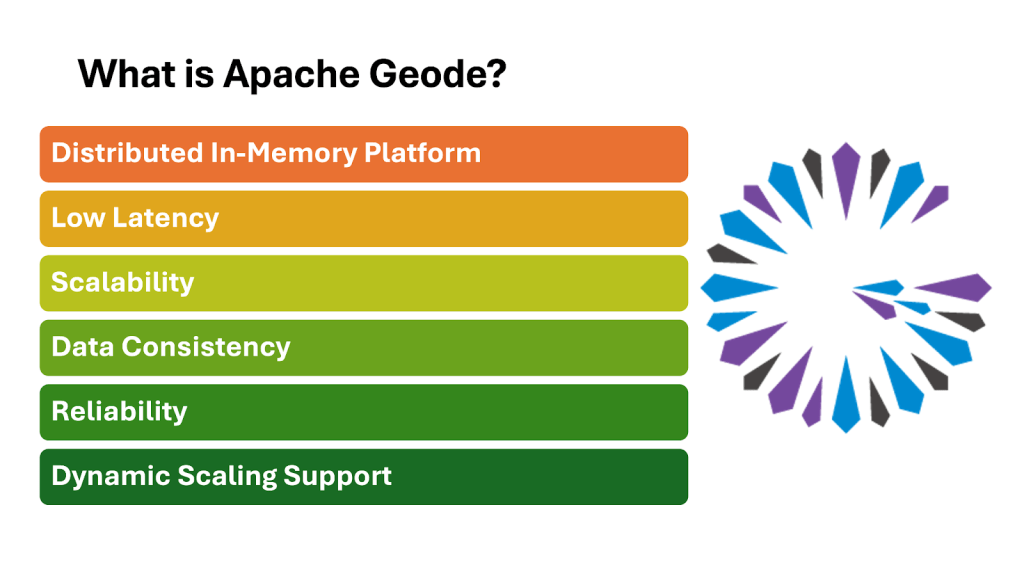
Apache Geode is a distributed, in‑memory data management platform designed for low‑latency, scalable, and consistent data access. It is built for systems that must react in real time, handle massive data volumes, and remain operational under failure. Data is dynamically partitioned or replicated across a cluster, with built‑in fault tolerance and optional persistence to disk.
As modern applications have shifted toward real-time analytics, event-driven architectures, and microservices, latency has become a central architectural constraint. Disk-backed storage systems, while durable and cost-efficient, often introduce millisecond-scale access times that are incompatible with sub-millisecond response requirements. In-memory data platforms address this gap by keeping active or frequently-accessed data in RAM, significantly reducing access latency and increasing throughput. This approach is particularly important in domains such as financial services, telecommunications, e-commerce, and IoT, where responsiveness, scale, and availability directly influence user experience and operational outcomes.
At its core, Geode aggregates memory, CPU, and network resources across multiple nodes into a single, coherent data fabric. Applications continue running even when individual nodes fail—no blinking, no downtime. Geode supports multiple deployment models, including peer‑to‑peer, client/server, and multi‑site configurations, enabling it to scale from tightly coupled application clusters to geographically distributed systems.
From GemFire to Geode—and Almost to Obsolescence
Apache Geode’s lineage traces back to 2002, when GemStone Systems introduced GemFire, a commercial platform widely used in financial services for real‑time workloads. Through acquisitions—GemStone to SpringSource, then to VMware, and later to Pivotal—the technology evolved before being open sourced in 2015 and donated to The Apache Software Foundation as Apache Geode.
For several years, the project thrived. But after 2019, corporate shifts and changing priorities reduced contributor engagement. By 2022, most committers were inactive. By mid‑2023, development had stopped entirely. In 2024, the PMC voted to terminate the project. Apache Geode appeared to be finished.

Apache Geode Contributors Over Time
Then came 2025. I began upstreaming my internal fork. The community delivered Apache Geode 1.15.2 in September, followed by Apache Geode 2.0 in December. What looked like an ending became a comeback—a transition from long winter to spring.
By the time Apache Geode’s revival began, it was clear that survival alone was not enough. To remain viable, trusted, and relevant, the platform would need far more than incremental fixes—it would need a complete modernization from the ground up.